Is It Defiance or Dysregulation? How to Tell the Difference
When your child reacts to what you’d consider small requests with big emotions, there’s usually a lot more going on under the surface. It’s easy to understand our child’s challenging behaviors as defiance, but often it’s not about defiance, its dysregulation.
The Behavior You See On the Surface
Maybe your child is refusing to do school work or has a meltdown every morning when the time comes for leaving for school. Maybe they’re just avoidant and look like they’re procrastinating. They won’t get started. First they need a glass of water, then they need to get a snack, then they need to go to the bathroom, then their shoes are uncomfortable and they need to change them…and so it goes on. And the longer they take to get started, the more frustrated you get, the more you push the more they resist.
Maybe they’re giving you “attitude”, rolling their eyes or telling you a flat out no! The more you ask and appeal, the more defiant they get. This can become a “tantrum” where they’re shouting at you, slamming doors. If you know, you know…
Maybe it looks like sudden silly behavior, goofing around, they’re making jokes or making silly noises, laughing hysterically at the most inane thing, or they’re swinging on their chair, lying upside down while they try and write the answers down.
Or maybe they just shut down. They may become tearful and appear anxious, but there’s nothing you can say that’ll convince them they can do it, nothing you can do to get them started. Or maybe they just switch off, staring out the window, or at the work possibly, but they’re completely disengaged.
These moments are SO hard for us as moms, because they trigger really big feelings in us.
Why is my child fighting me on this? Why can’t they just start – is it really so hard? Or, they’re so close to finishing, can they just get it done?
Their “rude and disrespectful” behavior is a particular trigger because this was not tolerated when we were children and it had some pretty severe consequences. How is my child going to respond to authority figures and deadlines and client requests one day!? There are tons of demands in the real world that won’t move out of their way because they don’t want to face them.

Your Child’s Nervous System and What’s Beneath The Surface
In order to understand these behaviors we’re seeing in our children, we need to understand a bit more about their nervous systems. Because as we’ll discover, these behaviors are more related to dysregulation than defiance.
Neuroscience of safety
When we’re faced with a danger or threat, parts of our brain are activated so that we can take action to stay safe. So this programming or mechanism is there to keep us safe. Any time we perceive a danger, this gets activated.
This is the fight-flight-freeze-fawn response.
The problem with this mechanism is that it’s not very good at discerning when something is a real threat or danger or if it’s just a perceived threat. It fires in the same way, regardless. So sometimes we respond to things that aren’t actually threats as if they were a life-and-death situation and require us to activate full survival mode.
Another part of neuroscience you also need to know
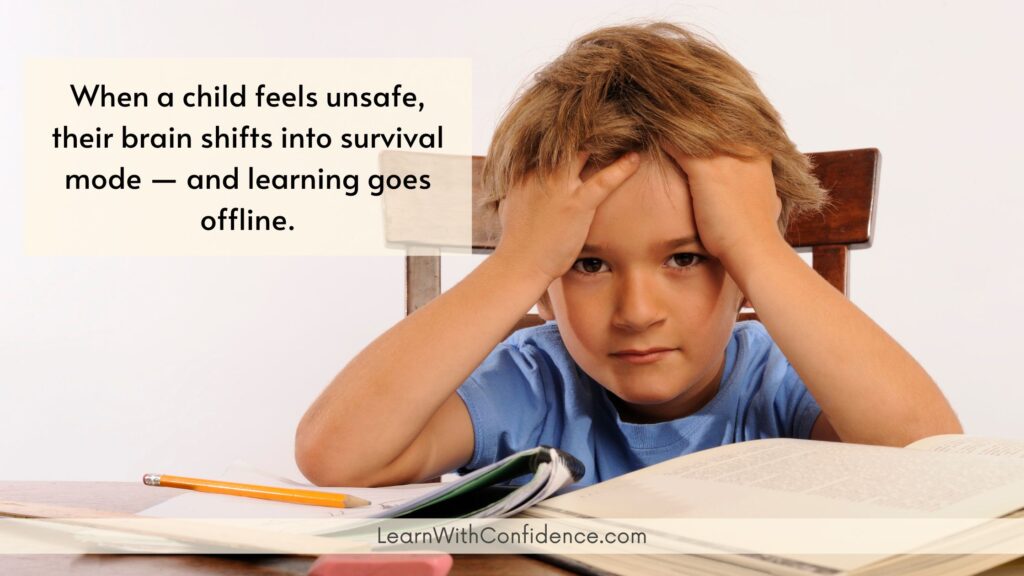
When this survival mode is activated, the parts that are used for rational thinking, problem solving, analysing, planning, organization, emotional control, and much more, go offline.
Why because when you need to make a quick getaway or you need to fight for your life, you actually don’t want to have your brain processing different scenarios, analysing the pros and cons and eventually coming to the best decision. You need fast action driven by the need to stay alive.
So why is this relevant to my child’s behavior?
Those behaviors your child is struggling with right now (or more likely, you’re struggling with) are often rooted in this survival response.
No, they are not in any actual danger when they open their Math book, but suddenly their brain feels threatened and they flip into survival mode.
No, being asked to pick up your shoes for the 10th time is not actually a life-threatening experience (well, at least I hope not!) but that’s how their brain perceives it and cue the meltdown.
So if you look at your child’s behaviors through that lens, it’s very interesting:
- Anger, arguing – it’s a fight response
- Avoidance, distraction, procrastination – it’s a flight response
- Shut down, blanking out, forgetting what they were doing – it’s a freeze response
- People-pleasing or compliance because of fear of rejection and punishment – it’s a fawn response
Is my child being defiant or are they just dysregulated?
This question is gold, because it’s going to determine how you respond to your child and what support they need. The core difference between defiance and dysregulation is in the root cause of the behavior.
Comparing Defiance and Dysregulation
When a child is being defiant it is a conscious and clearly intentional decision to break rules or actively not comply with rules. The goal of the behavior is exerting control. When your child is being defiant they may struggle to show remorse afterwards. Defiance originates from the “thinking brain” – there’s purpose and intention and consideration.A child who is being defiant needs firm, consistent boundaries, the foundation for discipline (discipline as in teaching and correcting, not as in punishment – but that’s a discussion for another day!).
Dysregulation originates from the survival brain. It’s an involuntary, automatic nervous system response to overwhelm, fear and feeling “in danger” (even when there isn’t any true danger). Behaviors can look very similar to defiance, especially when it comes to refusal. But the motivation behind the behavior is survival. A child who is dysregulated needs support to calm their nervous system down so they feel safe and can think rationally again.
How to discern – do they “know” what they are doing and do they have a conscious intention behind it?
Can they co-exist?
The simple answer is yes. And this is where it becomes tricky. Because even if the root of the matter is survival-based, your child can become increasingly defiant in an effort to continue protecting him- or herself.
A need for autonomy (or experiencing a loss of autonomy) can trigger defiance or dysregulation, for example. A child may not feel “safe” if their autonomy is taken away (or they think it has been), their nervous system feels like in order to survive, it must fight for that autonomy. When a child is defiant about this, it’s usually a matter of they don’t like it and want to be in charge, not because they feel unsafe.
And sometimes it’s REALLY hard, in the moment, to discern which is which. We’ll discuss how to respond to this in a little bit.
Dysregulated Brains Can’t Learn
If homework and homeschool feels hard right now because of the behaviors we chatted about earlier, then it’ll be valuable to consider whether these are based in defiance or in dysregulation.
The reason you’re having trouble with this is because dysregulated brains cannot learn effectively.
As mentioned earlier, the parts used for learning are primarily located in the frontal cortex – the very part that goes offline when our brains are in survival mode (fight-flight-freeze-fawn). They can’t access rational thinking, problem solving, analytical thinking, emotional control, response inhibition, and more. They can’t access what they know.
Besides some of the behaviors mentioned earlier, this may look like forgetting work they know, making silly mistakes and giving up easily when it feels like too much or too difficult.
Parenting Reframes That Will Make All The Difference
And because of this, we need a reframe: What if it’s dysregulation and not defiance?
All behavior is communication. We just have to learn to “read” what our child is communicating.
Maybe your child isn’t trying to be rude and disrespectful, they’re just overwhelmed and their immediate response is to shout at you or give you “attitude”.
Maybe your child has come across some work that feels too difficult or there are just too many questions to answer. Their shutdown may be that freeze response and they literally have no idea where to even begin.
Maybe your child is racked with self-doubt about a particular topic and this leads to avoidance, because you can’t fail at something you’ve never tried.
We can start moving from responding in shame and blame, to curiosity: Why are they triggered right now?
We can move from needing to exert control over them to responding from a place of interest and connection.
And finally, in terms of support, we can shift from feeling the need to punish them to a place of regulation support.
Regulation Comes Before Learning
So what’s a mom to do!?
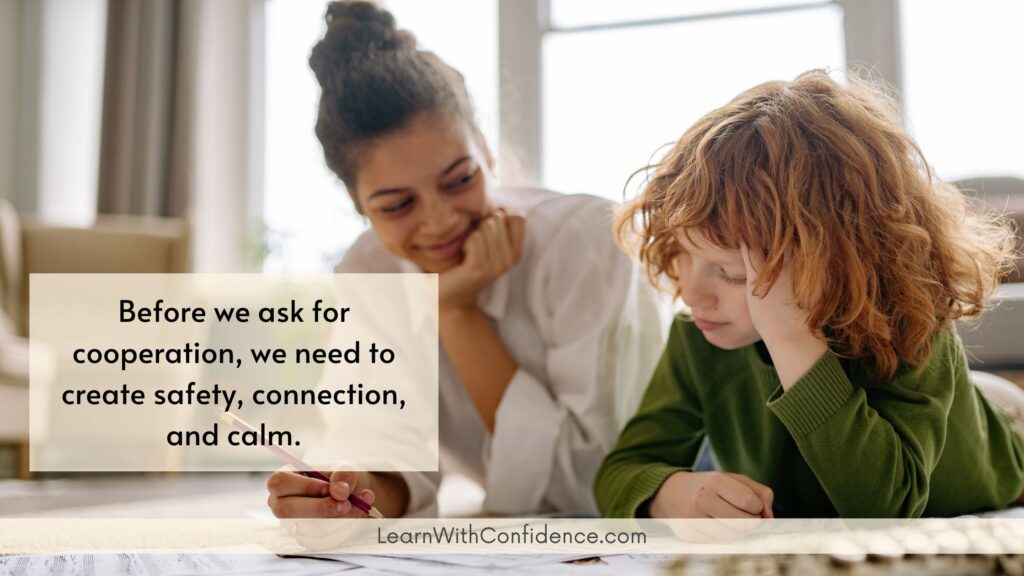
Regulation is a prerequisite to learning.
Teaching your child calming techniques or strategies while they’re dysregulated will not work.
Asking them to reflect on why they’re struggling in that moment of dysregulation is unrealistic.
Expecting them to learn new concepts in Math or any other subject, practice them and store them in their memories for future use, is near impossible.
Not because they dont want to or they’re refusing to try, simply because the parts of the brain that do all that are offline.
Calming your child’s nervous system out of survival mode, allows their thinking brain to come back online, and then learning becomes possible again.
What You Can Do Today
Helping your child regulate so they can unlock their learning potential requires 5 steps:
- Creating Safety – both real AND perceived
- Building Connection
- Regulation
- Cooperation
- Learning
Mama, you gotta know that you’re not failing, your child isn’t broken. This is something you CAN learn how to support better and improvement is definitely possible.